CityTalk Live Webinar
5 Key Takeaways
1. A Main street isn’t a transaction, it’s an experience and a relationship
Janette MacDonald, a 17-year veteran of London, Ontario’s BIA, former community manager of the My Main Street Community Activator, and now a “hired gun” at My Connects, points to the redevelopment of St. Thomas as an example. As the city prepares for the influx of employees and residents that will come with the opening of the Volkswagen plant, the city must consider where folks will gather. “Besides the market and a couple of coffee shop,” Janette commented, “there needs to be a lot more public space that is well-maintained and kept clean and safe so that more people will go there.” Small businesses make up a huge part of our economy, and, as MacDonald put it, “if you keep feeding the golden goose, the golden goose is going to keep laying eggs. Your main street is in the highest tax bracket or mill rate in the city. If they can afford to pay their taxes, it benefits the rest of the city. That’s something councils need to be looking at when they’re budgeting for downtowns. Capital investments are fantastic. But we need operating and maintenance budgets to go with them.”
2. Main streets are increasingly about main floors and mixed-use
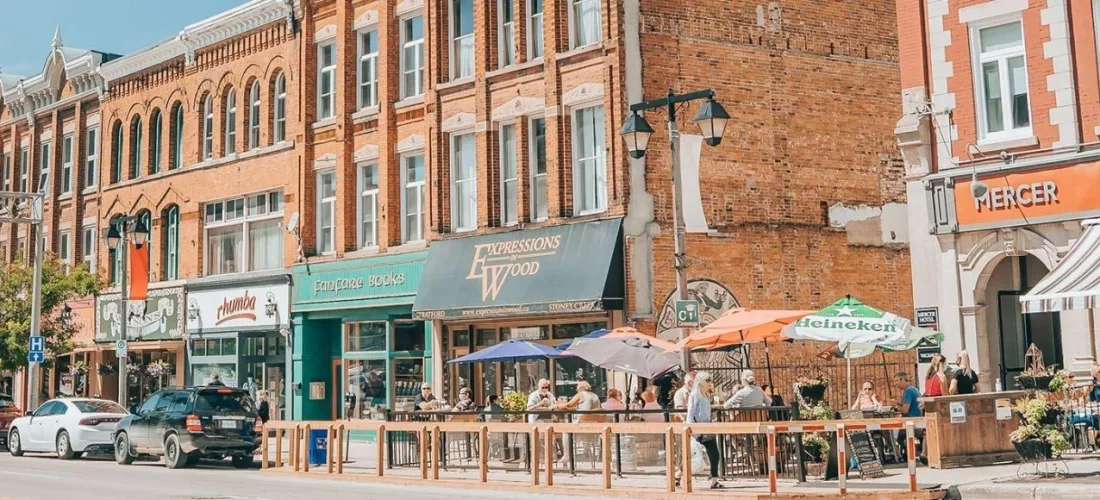
Density means more mixed-use spaces with ground floor commercial units. Adam Lubinsky, Managing Principal at WXY architecture + urban design, explained that in East Harlem in New York City, limiting the square footage eaten up by large retail chains and ensuring commercial units stay small allows smaller allowed independent retailers to remain on main streets. “It’s just constraining the floor plate size of the footprint,” Lubinsky says. “It’s also about combining different uses, including maker spaces with front-of-house retail. In the past, maker spaces were seen as manufacturing, but they’re really just light industrial.” Dorian Moore, CUI Fellow, added that “the smaller the spaces, the easier it is to get local entrepreneurs involved.” Even on “micro main-streets” such as Unionville, Ontario, there are opportunities and barriers to multi-use space. Sonia Chow, executive director of the Unionville Business Improvement Area shared how commercial use of residential homes often leads to visitors not realizing that there are multiple retailers in a building. Lots of promotion is required, and obstacles crop up; for example bylaws still prohibit sandwich boards on historic sidewalks, so these upstairs businesses can’t put out directional signage to bring in foot traffic. Cities must work to ensure they identify and solve these obstacles, keeping bylaws and permits in line with progressive changes.
3. Four considerations: buildings, public spaces, mobility, connectivity
Moore identifies four key areas that he feels cities must address for main streets to remain resilient. First, buildings should be considered assets and investments, particularly in smaller towns with historic or heritage structures that need to be rehabbed or even rescued from the wrecking ball. Second, cities should invest in parks, playgrounds, and plazas that act as “attractors for people to main streets.” The third area is mobility. “I think quite often we get concerned with how people are going to visit main street by car,” says Moore. “But we’ve transitioned into a number of other viable transportation modes, like bicycling and ride sharing, to address mobility through the main street area.” And finally, connectivity. “How do you make it easy to access main street from the community, the neighbourhoods that surround it? And how does it connect to other main streets within the area?” Mary Rowe added that, by definition, a main street is a connector. “It’s not a dead end,” she observed. “It’s a connection to something else.”
4. Main streets promote equity, but only with support
Omer Ismael, economic business officer with the City of Toronto, observed that communities like Little Italy, Chinatown, and Little Jamaica developed their own main streets based on migration and the desire for cultural connections. Now these communities are under pressure from rising housing, real estate, and commercial costs, and from ongoing redevelopment and construction projects. What can be done to help support business communities, BIAs. and Toronto’s diverse main streets? “It’s not always financial,” Ismael says. Consider also what can be done to bring new businesses into these communities, including making grants and financial or community supports more accessible, repurposing vacant properties for new entrepreneurs or expanding small businesses, and supporting businesses navigating the relocation process. Moore agrees. “Incentivize the training of small business entrepreneurs to inhabit these spaces, so that everything becomes local and familiar, creating an identity for the main street.”
5. The ”G-word:” does density always mean gentrification?
Lubinsky believes that governance and management play a role here. “There are opportunities for commercial community land trusts to occupy ground floor spaces, for bids to be master lessees. They would have a lease on a large number of ground floor spaces, and they can really curate those spaces, acting as a broker between landowners, landlords, and new businesses…. It’s really a combination of how you’re managing some of these ground floor units, and how you’re designing and regulating the street space as well.” Moore observed that in Ontario, density is “coming up against the market, and the market breeds sameness.” Governments must be involved in the “planning side,” not only locating affordable housing, but ensuring that retail and commercial growth meets the needs of neighbourhoods. “Density drives the demand for businesses to cater to individuals,” Moore says. “Governments really need to enact some strategic planning moves to create that demand and solidify main street.”